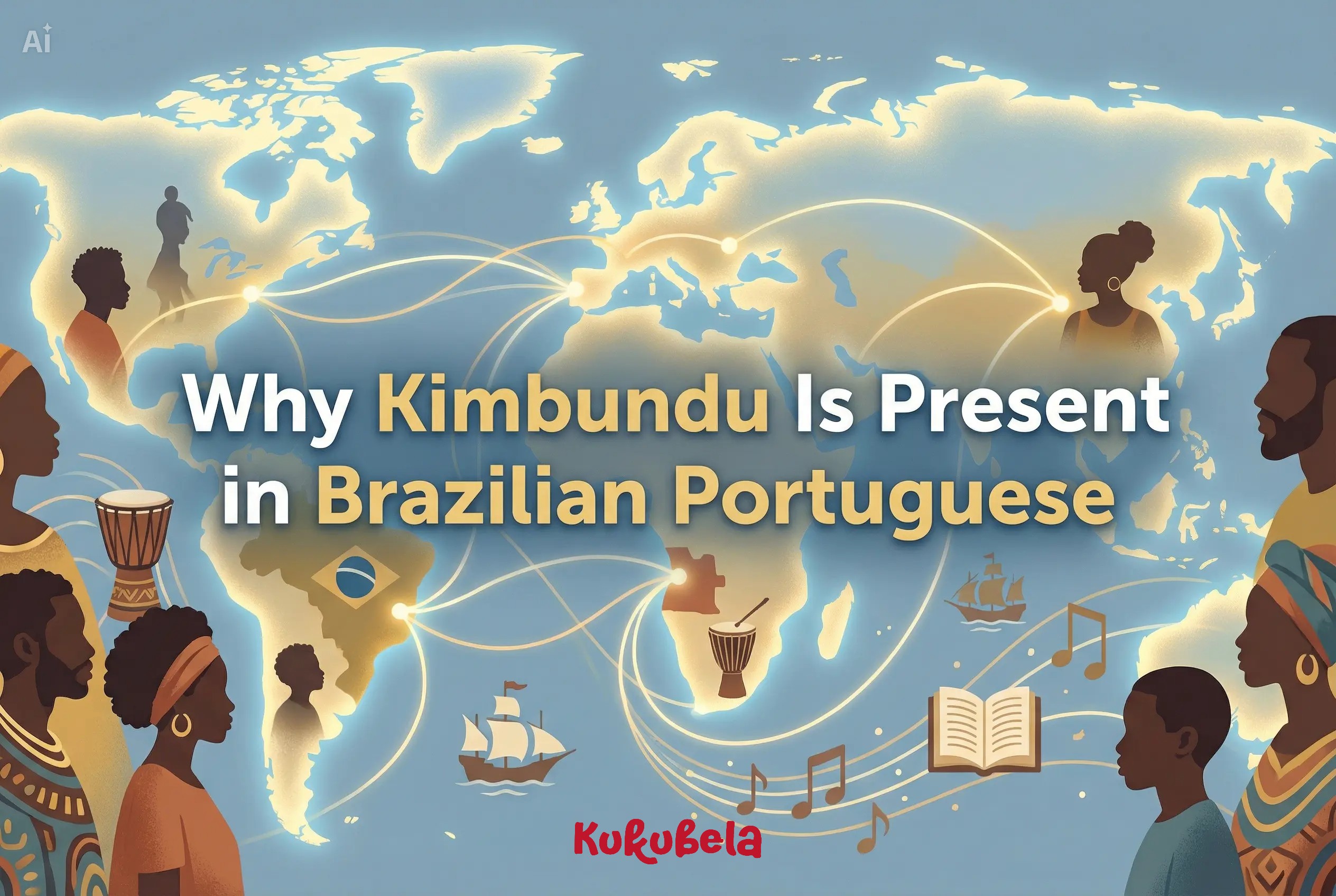
Why Kimbundu Is Present in Brazilian Portuguese
Some words cross oceans without asking permission. They arrive attached to people, memories, ways of dancing and cooking, and settle into a language as if they had always been there. That is what happened with Kimbundu, one of the most widely spoken Bantu languages in Angola, which was forcibly brought to Brazil between the 16th and 19th centuries and left such deep marks on Brazilian Portuguese that today millions of people use them without knowing where they come from.
When a Brazilian calls the youngest child “caçula”, they are using a Kimbundu word. When they give someone a cafuné, they are too. And when they listen to samba—that rhythm the whole world recognizes as a symbol of Brazil—they are actually hearing an echo of Angola.
This is not trivia. It is living history. And it deserves to be told with the rigor and pride it belongs to.
The route no map wanted to show
Between 1550 and 1850, Brazil received approximately 4.9 million enslaved Africans—the largest number of any country in the Americas. A significant portion came from the ports of Luanda and Benguela in Angola. Most were speakers of Bantu languages, especially Kimbundu, the language of the Ambundu people, who inhabited (and still inhabit) the central-western region of Angola, including the area of today’s capital.
Once in Brazil, these men and women were dispersed across plantations, mills, and cities. Colonial authorities believed that dispersal would destroy cultural ties—and with them, any possibility of organized resistance. They were wrong. Language does not disappear that easily.
How a language survives without schools or writing
Kimbundu did not survive in Brazil by decree or social prestige. It survived in the only way an oppressed language can: inside homes, in songs, in rituals, in stories told at night, in the names given to children, and in markets where Black women traded and negotiated among themselves.
Over time, Kimbundu did not remain unchanged—languages rarely do in diaspora. Instead, a process of blending and sedimentation occurred: Kimbundu words and structures were absorbed into colonial Portuguese, transformed, adapted phonetically, and remained. They remained in domestic vocabulary, in emotional expression, in music, and in food. They remained precisely in the areas of life where enslaved people had some degree of autonomy.
What resulted from this linguistic transfer is one of the most extraordinary cultural phenomena in the history of the South Atlantic: an African language shaping how a country of over 215 million people speaks.
The words that came from Angola
These are not academic guesses. These are words with documented Kimbundu roots, recognized by linguists on both sides of the Atlantic. Each one is proof that no ocean can erase a culture.
Samba
Perhaps the most famous of all. In Kimbundu, semba refers to the gesture of touching navels—a dance movement symbolizing connection, celebration, and vitality. In colonial Brazil, the word became “samba,” and the gesture evolved into a musical and dance genre now recognized worldwide as Brazilian. Its Angolan origin is not a detail—it is its birth certificate.
Caçula
From Kimbundu kasule, meaning the youngest child. In Brazil, it is used with exactly the same meaning, across the entire country. Few words have traveled so directly and preserved their meaning so perfectly.
Moleque
From Kimbundu mu'leke, meaning a boy or male child. In Brazil, the word developed different connotations over time—sometimes affectionate, sometimes pejorative—but its original meaning is neutral.
Quitanda
In Kimbundu, kitanda refers to a stall or table where food is displayed and sold. In Brazil, “quitanda” came to mean a small neighborhood grocery store. In Angola, both the concept and the word still exist today.
Fubá
From Kimbundu fuba, referring to flour (originally from maize or cassava). In Brazil, “fubá” specifically refers to cornmeal used in traditional dishes such as angu and cornbread. It is a staple ingredient with a name that came directly from Angola.
Dendê
From Kimbundu ndende, referring to the oil palm and its fruit. Palm oil (azeite de dendê) is central to Bahian cuisine, and its name preserves its Kimbundu origin intact. Without dendê, there is no acarajé. Without Kimbundu, there is no dendê.
Cafuné
Perhaps the most emotionally powerful word on the list. In Kimbundu, kafuné describes the act of gently running fingers through someone’s hair—a gesture of care and affection. In Brazil, the meaning remains exactly the same. One of the most recognizable gestures of Brazilian affection has an Angolan name.
Quilombo
From Kimbundu kilombo, originally referring to a mobile military camp among the Mbundu people. In Brazil, it was redefined as communities formed by escaped enslaved Africans. Quilombo dos Palmares, the most famous, once had tens of thousands of inhabitants. The word for this resistance came from Angola.
Miçanga
From Kimbundu misanga, meaning glass beads used in jewelry and adornments. In Brazil, “miçanga” carries exactly the same meaning. These beads were also used as trade items in Angolan ports during the colonial period—connecting the word to the very system that transported it.
Quizumba
From Kimbundu kizumba, meaning confusion, quarrel, or disorder. In Brazil, “quizumba” is used in some regions with the meaning of a fight or argument. The word kizomba, which in Angola refers to a music and dance genre, shares the same root—an interesting contrast between celebration and conflict.
What this means today
There is a persistent idea that African cultures arrived in Brazil only as victims—erased, destroyed, surviving only in fragments. This idea is not only incomplete; it is unjust. What Kimbundu did to Brazilian Portuguese is not accidental or residual—it is an active, creative, and lasting contribution from a people who, even under extreme violence, did not give up who they were.
The words listed above are not exotic exceptions. They are everyday language—used in food, music, affection, and daily life. They are central, not marginal. And the fact that most people do not know their origin does not diminish their presence—it only makes it more urgent to tell this story.
Understanding the origin of these words is a way of restoring visibility to a people and a language that helped shape one of the most populous countries in the world. It is also a way of recognizing that Angola and Brazil share something no diplomatic treaty created: a linguistic kinship over four hundred years old.
Learn Kimbundu with Kukubela
If any of these words made you curious—if you started wondering what Kimbundu sounds like, how its grammar works, or what other surprises it holds—Kukubela exists for exactly that purpose.
With more than 35,135 users worldwide, Kukubela is the platform that makes African languages accessible to anyone, regardless of where they live or where they are starting from. Kimbundu is there, taught with both rigor and cultural closeness.
You don’t need to be Angolan to learn it. You just need curiosity—and you’ve already proven that you have it.