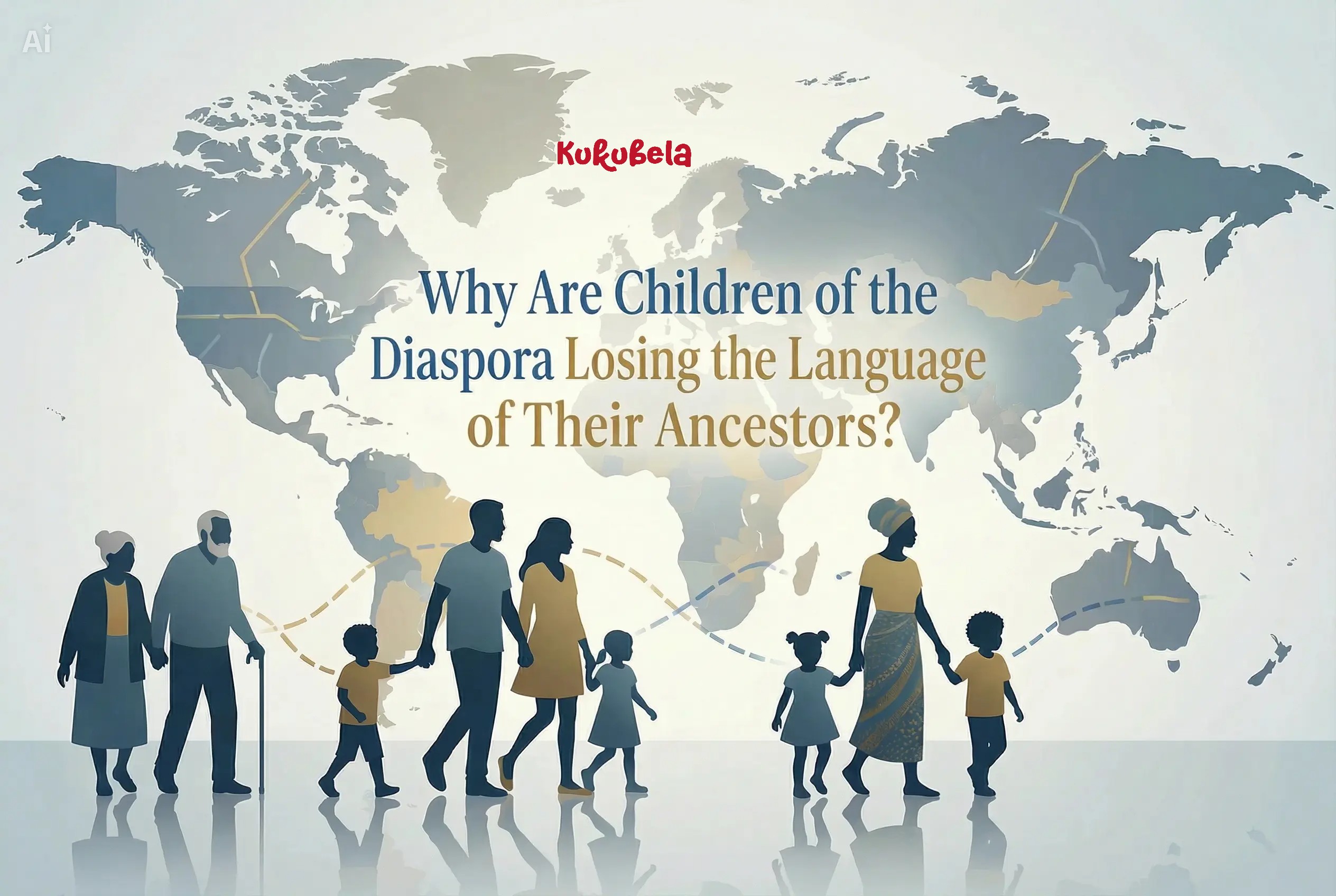
In many parts of the world, children of Africans living in the diaspora grow up either not speaking or speaking very little of their parents’ and grandparents’ languages. While many may understand a few words or expressions, fluency often does not develop.
This phenomenon raises an important question: why are ancestral languages disappearing among younger generations in the diaspora?
What is the African diaspora?
The African diaspora refers to communities of people of African origin living outside the continent, whether due to recent migration or historical processes.
Today, African communities can be found in:
- Europe
- North America
- South America
- The Middle East
In these contexts, daily exposure to the original language tends to decrease.
The dominant language of the environment
Children learn the language they hear and use most in their daily lives.
In the diaspora:
- school is in the country’s language
- friends speak the local language
- digital content is in the dominant language
As a result, the ancestral language becomes secondary — or even absent — in everyday use.
Lack of transmission at home
One of the most decisive factors is the absence of practice at home.
Many parents:
- choose to speak only the country’s language to help their children integrate
- fear confusing the child with multiple languages
- or do not insist on using the mother tongue
Without consistent practice, the language stops being passed down.
Shame and social pressure
Just like in urban African contexts, shame can also appear in the diaspora.
Some young people feel that:
- speaking their parents’ language may “set them apart” too much
- they may be mocked or excluded
- the language has no practical use in their environment
This often leads to gradual abandonment.
Fragmented identity
Many young people in the diaspora grow up between two (or more) identities:
- the culture of the country where they were born
- the culture of their parents
Without support, this duality can lead to distancing from the heritage language, which may feel irrelevant or disconnected from daily life.
Lack of modern resources
For a long time, learning African languages outside Africa was difficult.
There was a lack of:
- apps
- accessible books
- digital content
- available teachers
Without tools, interest rarely turns into actual learning.
Consequences of language loss
Losing ancestral languages has real consequences:
- cultural disconnection
- difficulty communicating with older family members
- loss of stories, proverbs, and traditions
- weakened sense of identity
A language is not just a means of communication — it is a system of thought and collective memory.
Is it possible to reverse this situation?
Yes — but it requires intention and consistency.
Some effective strategies include:
- encouraging the use of the language at home
- exposing children to content in the language (music, videos, stories)
- creating safe spaces for practice
- using technology as an ally
The role of technology
Today, technology makes it possible to recover what once seemed lost.
Apps, social media, and digital platforms allow people to:
- learn at their own pace
- listen to native speakers
- practice daily
- connect with other learners
This is especially important for those living far from their country of origin.
Reconnecting with the language is reconnecting with yourself
Learning an ancestral language is not just a linguistic exercise — it is an act of identity.
For children of the diaspora, reclaiming the language can mean:
- strengthening family connections
- better understanding their own history
- feeling more culturally complete
Conclusion
The loss of languages in the diaspora does not happen by chance — it is the result of social, historical, and cultural factors.
But this loss is not irreversible.
With awareness, access to resources, and the willingness to learn, it is possible to recover, preserve, and pass these languages on to future generations.
Because when a language is reclaimed, an entire story begins to be told again.