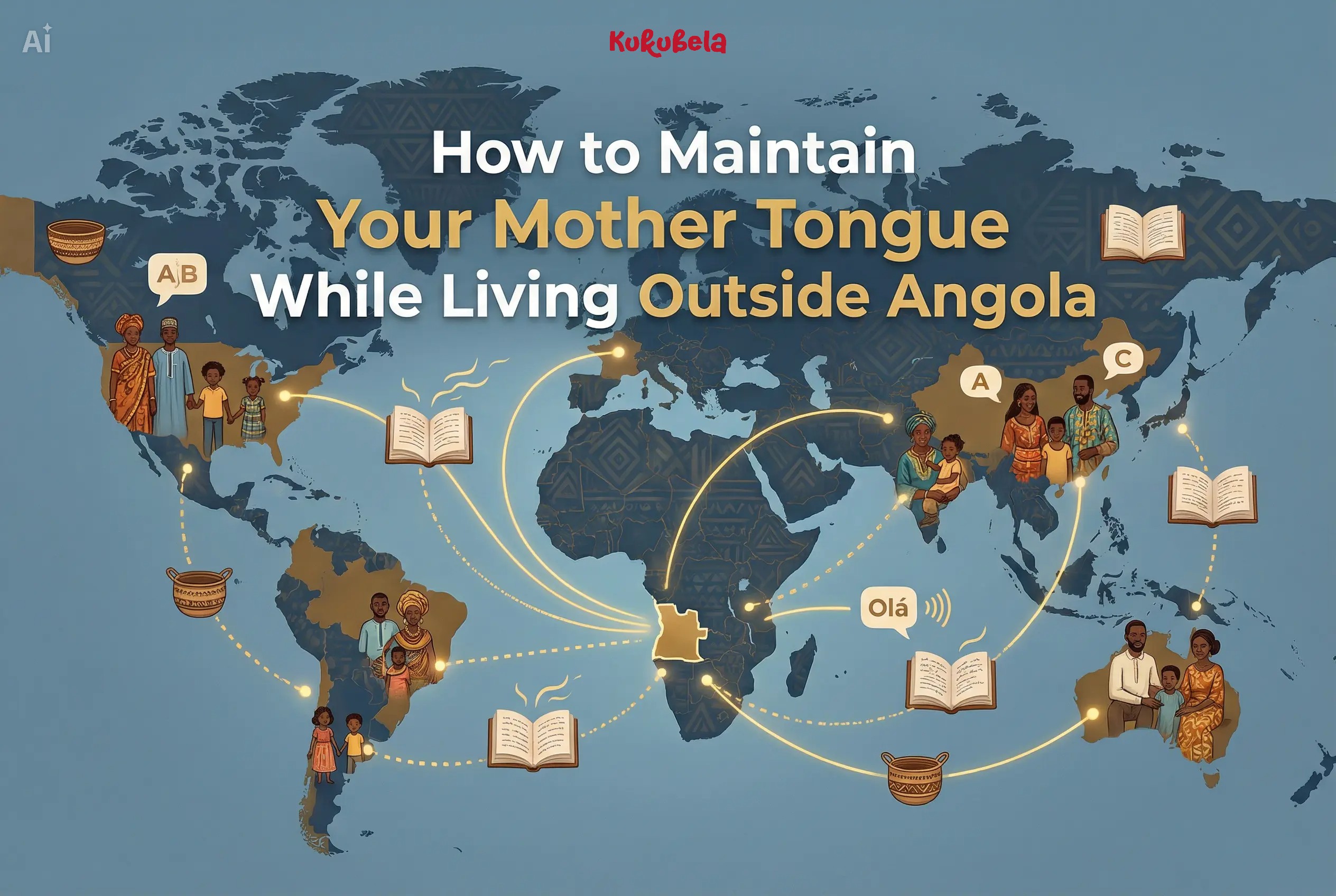
How to Maintain Your Mother Tongue While Living Outside Angola
It’s something many people in the diaspora recognize instantly.
You speak to your child in Kimbundu — a simple question about dinner or their day at school — and they answer in Portuguese. Not out of defiance. Not out of a lack of love. But because it’s the language they think in, dream in, and exist in within the world around them. You understand what they say. They only vaguely understand what you said. And in that space between two languages, there’s something that tightens in your chest — something hard to name.
This isn’t failure. It’s the predictable result of growing up in a European or American city where Kimbundu doesn’t exist in the streets, in schools, or on screens. A language doesn’t disappear because families neglect it — it disappears because of contextual pressure. And that makes all the difference in how we should approach this challenge.
The good news is that a language that still lives inside the home can be preserved. Not perfectly, not without effort, but through real and practical ways that don’t require turning your life into a permanent classroom.
Language is more than communication
Before getting into strategies, it’s worth pausing here: why does it matter so much?
The most immediate answer is practical — speaking Kimbundu opens doors in Angola, brings generations closer, and strengthens relationships with family back home. But there’s a deeper reason that practicality alone can’t fully explain.
Language is the container of culture. Not in a decorative sense, but in a structural one. There are ways of seeing the world, organizing relationships, and expressing respect, affection, and authority that exist in Kimbundu and simply don’t have direct translations. When a young person in the diaspora loses the language, they don’t just lose a communication tool — they lose access to an entire layer of meaning. They lose the ability to fully understand a grandparent’s joke, to interpret proverbs, to grasp why certain things are done a certain way.
This is not an argument to blame those who moved abroad and saw the language slip away while managing daily survival. Life in the diaspora is demanding, and priorities are many.
5 practical ways to keep Kimbundu alive
1. Create language routines at home
Language survives in small rituals. You don’t need to declare that “only Kimbundu is spoken at home” — that kind of rule often creates resistance, especially among teenagers. What works better are specific and consistent moments: dinner time, bedtime, or a weekly call with grandparents.
Choose one context and protect it. If dinner is always in Kimbundu, after a few months that association becomes stable. The language gains a place in the day — and places are easier to defend than abstract rules.
For younger children, the approach is even simpler: speak to them in Kimbundu about what they care about. Not grammar, not abstract Angola — but cartoons, school, football. Language sticks to emotions, and emotions are the strongest glue there is.
2. Use music as a gateway
Music is probably the most effective way to transmit a language to children, teenagers, and even adults who want to refresh what they know. Semba, kuduro, kizomba with more lyrical depth — there’s a vast repertoire of Angolan music that uses Kimbundu or blends it with Portuguese in ways that teach without feeling like teaching.
Create a playlist for the car, for meals, for weekends. You don’t need to explain every word — repeated exposure does the work. Over time, you’ll naturally start asking what certain lines mean, and that opens conversations far more valuable than any formal lesson.
3. Bring back oral storytelling
Angola has a strong oral storytelling tradition: folktales, proverbs, animal stories with embedded morals. Many of these stories exist in Kimbundu or were originally told in it before transitioning into Portuguese.
If you remember stories from your childhood, tell them. If you don’t, ask elders — parents, uncles, anyone from the generation that still carries them. Oral storytelling doesn’t need to be perfect or academically correct. It just needs to be told. A story repeated once a week for a year creates a bond that lasts decades.
There are also increasingly more digital resources: recordings, YouTube channels, Facebook groups from Angolan communities where these stories exist in accessible formats. Digital doesn’t replace a grandparent telling a story live — but it’s infinitely better than silence.
4. Connect children with other speakers
One of the biggest challenges in the diaspora is linguistic isolation: children grow up without peers to speak the language with. For them, Kimbundu becomes the language of adults and obligations — not of play and choice.
Whenever possible, create opportunities for interaction with other Angolan children. Community gatherings, family groups in the same city, regular video calls with cousins in Luanda. When a child realizes there are others like them using the language, resistance decreases. The language stops being a family quirk and becomes part of a shared identity.
5. Use a structured platform to reinforce what’s learned at home
Informal transmission — what happens at the dinner table, through stories and music — is irreplaceable. But it can also be fragile, because it depends on memory and time. A structured learning platform complements this effort in ways that family conversations alone cannot: it teaches grammar without feeling like grammar, organizes vocabulary around real-life contexts, and allows both parents and children to progress at their own pace.
Kukubela was built exactly for this context. Not for academics, but for people like you — who want to keep the language alive across generations without turning the home into a classroom. Kimbundu is there, available on any device, anytime. For those ten free minutes on the subway, or when you want to prepare a story for the weekend.
One last thing
Keeping a language alive in the diaspora is not the task of one person or even one generation. It’s a collective project built in layers — one dinner at a time, one story at a time, one song at a time. There will be weeks when you can’t keep up. There will be phases when children resist more than they cooperate. That’s normal — it’s not failure.
What matters is not letting silence settle in permanently. As long as the language still exists at home — even in fragments, even mixed, even imperfect — there is something to preserve and pass on.
Try Kukubela today, no commitment
If this article made you think about your children, your parents, or simply the language you grew up with, Kukubela has a starting point for you.
The platform has already helped more than 35,623 people worldwide learn and reconnect with Angolan languages. Kimbundu is there — structured, accessible, and designed for real life far from Angola. You can try it for free, with no card and no commitment, and see for yourself what’s possible when technology serves culture instead of ignoring it.
The language that shaped you is still waiting. Sometimes it just needs a place to breathe.