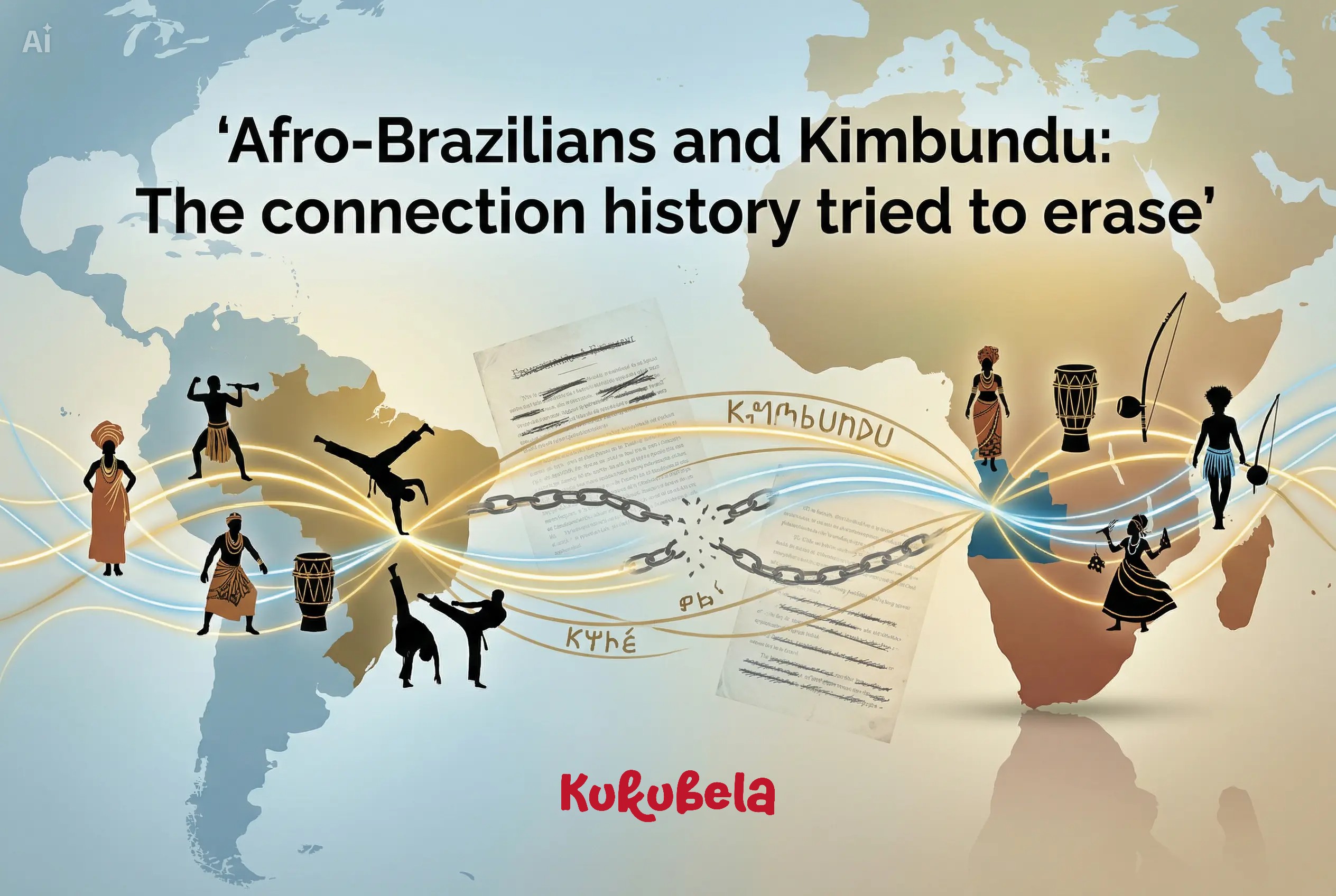
Afro-Brazilians and Kimbundu: the connection history tried to erase
Between 1550 and 1850, approximately 4.9 million enslaved Africans arrived at Brazilian ports. Of this total, it is estimated that more than 40% came from Angola, from the ports of Luanda and Benguela, where slave ships lined up with the brutal regularity of any commercial route. This means that, out of every ten enslaved people who arrived in Brazil, at least four were Angolan. At least four spoke Bantu languages. Many of them spoke Kimbundu.
This number is not an abstract statistic. These are people with names, families, and histories that were systematically destroyed by the colonial machine. But there is something that this machine could not completely destroy: language.
Kimbundu arrived in Brazil in chains, survived in collective memory, and left marks that are still present today in the way millions of Brazilians speak, pray, dance, and exist.
This is the story that does not appear in history books. And it is time to tell it.
What is Kimbundu and where it comes from
Kimbundu is a Bantu language spoken mainly in the central-western region of Angola, including the area of the current capital, Luanda, and neighboring provinces. It is the language of the Ambundu people, one of the largest ethnic groups in Angola, and it still has millions of active speakers today.
It is a tonal language, structurally very different from Portuguese, but with a strong natural musicality. It has a rich oral tradition: proverbs, stories, ceremonial songs, and forms of greeting that carry entire layers of social meaning. When the Ambundu people were enslaved and taken to Brazil, they did not come empty-handed. They carried everything a language holds within it.
Where Kimbundu survived in Brazil
In Candomblé and the terreiros
The deepest survival of Kimbundu in Brazil happened within religious spaces. Candomblé of Angola, also known in some regions as Bantu Candomblé or Caboclo Candomblé, preserved vocabulary, chants, and prayers in Kimbundu for centuries, transmitted orally from priestess to priestess, from parent to child, in circuits that colonial and later republican authorities repeatedly tried to criminalize.
Words such as nkisi (sacred entity), nganga (priest, healer), and mukongo (related to the Kongo people, but with strong interaction with the Kimbundu world) are part of a ritual vocabulary still alive in terreiros in Bahia, Rio de Janeiro, and Pernambuco. When someone enters a terreiro and hears foundational chants, they are hearing direct echoes of a language that crossed the Atlantic more than three hundred years ago.
The terreiro was not just a religious space—it was a living archive. It was where African cultural memory found minimal conditions for resistance and continuity. And Kimbundu was there, preserved in sacred words that could not be spoken aloud outside those walls.
In everyday Brazilian vocabulary
Kimbundu did not remain only in religious spaces. It flowed into Brazilian Portuguese so naturally that most people never stop to think about the origin of the words they use. Many everyday words have direct roots in Kimbundu:
Samba — from semba, the gesture of touching navels in Ambundu celebratory dances. The movement became rhythm, the rhythm became a genre, and the genre became a national symbol. Brazil exports samba worldwide without realizing it is exporting Angola.
Caçula — from kasule, meaning the youngest child. Used across Brazil with the same original meaning.
Cafuné — from kafuné, the act of gently running fingers through someone’s hair. One of the most Brazilian gestures of affection has an Angolan name.
Quilombo — from kilombo, a mobile military camp among Mbundu peoples. In Brazil, it was redefined as communities of resistance formed by enslaved Africans who refused captivity. The famous Quilombo dos Palmares carries a Kimbundu name.
Moleque, quitanda, fubá, dendê, miçanga — all with documented Kimbundu roots, all still present in Brazilian Portuguese today.
This presence is not accidental or peripheral. It is concentrated precisely in the domains where enslaved people had some autonomy: family, food, affection, and resistance.
In the music Brazil calls its own
Samba and Jongo
Samba has already been mentioned, but it’s worth going deeper. Jongo, an Afro-Brazilian rhythm from southeastern Brazil, especially in the Paraíba Valley and quilombola communities of Rio de Janeiro, has an even more direct relationship with Angolan musical traditions. The drums, the circular formation, the double-meaning verses used as coded communication among enslaved people—all of this has direct parallels with Bantu musical practices in Angola.
Jongo did not become a national symbol like samba. It remained on the margins, preserved by Black communities who understood it could not be lost. Today it is recognized as intangible cultural heritage by IPHAN—a late but meaningful recognition.
Maracatu
Maracatu, especially in its baque virado form from Pernambuco, carries deep Bantu influences, both in drum patterns and in elements of ritual vocabulary. The crowned Black king and queen figures reflect African royal traditions that enslaved people brought with them and refused to erase.
Every drumbeat, every procession, is an affirmation of cultural continuity across centuries of attempted erasure.
The reconnection movement: Afro-Brazilians seeking Angola
In recent decades, especially since the 2000s, there has been a growing movement in Brazil of Afro-Brazilians reconnecting with their African roots—and Angola plays a central role in this process.
This movement happens on many fronts: in Candomblé terreiros seeking to recover original Kimbundu pronunciation; in quilombola communities researching their specific ethnic origins; in urban cultural movements in Rio and São Paulo connecting funk, rap, and trap to ancestral rhythms; and in families traveling to Angola for the first time and feeling a deep, unnameable recognition.
There is also a political dimension. Knowing you have roots in Angola—that your ancestors belonged to a people with their own language, culture, and dignity before slavery—changes how you see yourself. This is not romanticism. It is individual-scale historical repair.
Learning Kimbundu, in this context, is not just a hobby or academic curiosity. It is both a political and emotional act. It is saying: this language existed, arrived here, survived—and I refuse to let it die with me.
What still needs to be done
Reconnection is happening, but in a fragmented way and without the resources it deserves. There is no large-scale teaching of African languages in Brazilian public schools, despite legal requirements to teach Afro-Brazilian and African history. There is no public policy for preserving Bantu languages in Brazil.
What exists are communities and individuals carrying this work on their own shoulders, often without institutional support.
This is where accessible platforms can make a real difference—not as a replacement for community work, but as a tool that brings knowledge to those far from terreiros, quilombos, or research centers. It allows someone in Manaus to learn Kimbundu with the same access as someone in Luanda.
Learning Kimbundu is an act of reconnection
If you made it this far, you’ve probably felt that there is something personal in this story—even if you don’t know exactly where your family fits into it. And perhaps precisely because of that.
Kukubela exists to make this path possible. With more than 35,632 users worldwide, the platform offers Kimbundu in an accessible, structured way designed for real people, not just academics. You can start today, at your own pace, with no prior knowledge required.
Learning the language of your ancestors will not undo centuries of historical violence. But it will return something that was taken—and that, by itself, is already a powerful beginning.